Rai Dress
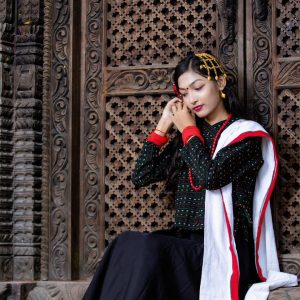
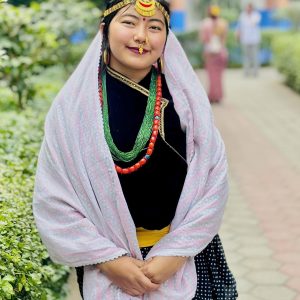
The Rai are an indigenous Kirati ethnic group primarily residing in the eastern hilly regions of Nepal. Their cultural dress is distinct, colorful, and symbolic of their rich heritage. While there can be some variations among the numerous Rai sub-groups, here’s a general overview of their traditional attire:
For Women:
Phariya/Lungi: This is a wrap-around skirt, often brightly colored and sometimes featuring floral or geometric patterns. It’s akin to a lungi or saree in its draping.
Chaubandi Cholo (Blouse): A traditional Nepali blouse that is typically double-breasted and tied at the sides. For Rai women, this is often made of Dhaka fabric, known for its intricate patterns and vibrant colors.
Patuka (Waistband): A long, often white, piece of cloth wrapped tightly around the waist, serving both a functional and aesthetic purpose.
Ghalek: A type of shawl or outer garment that is often draped over the shoulders, sometimes with sleeves tied in a particular way.
Ornaments: Rai women adorn themselves with a variety of traditional jewelry, which is a significant part of their cultural dress:
Sirful: A head ornament worn on the crown of the head.
Sirbandi: An ornament worn on the forehead.
Yarling: Large, often circular, earrings.
Dhungri: Smaller nose rings.
Bulaki: A prominent nose ring, often dangling.
Kantha Mala: A traditional necklace.
Hamel: A long, often green or colorful, beaded necklace.
Pote: Strands of colorful glass beads, a common adornment across many Nepali communities.
Paisa Mala: Necklaces made of silver coins.
Bangles (Bala/Kalli): Bracelets, often in gold or silver.
Khurmi Khurpeto: Ornaments tied on the patuka.
For Men:
Daura Suruwal: While considered the national dress of Nepal, the Daura Suruwal (a knee-length, double-breasted top and loose-fitting trousers) is also a significant part of Rai male attire. The Rai version might have slight variations in cut or fabric.
Waistcoat/Fenga: A waistcoat, often made from traditional fabrics like Allo (nettle fiber) or Dhaka, is worn over the Daura Suruwal.
Patuka (Waistband): Men also wear a patuka around their waist, often for practical purposes like holding a khukuri (traditional Nepali knife).
Dhaka Topi: The distinctive traditional Nepali cap, made from Dhaka fabric, is commonly worn by Rai men.
Wabu: A traditional water container, sometimes carried on the waist, can be a part of the cultural ensemble, especially during specific events.
Showing all 2 results